

How Our Brains Decide When To Trust
Essential trust
Essential trust: The brain scientific discipline of trust
Play
Sign upward for the On Signal newsletter hither.
This is part 2 of our series Essential trust. Notice part I here.
What happens in your brain when you lot determine to trust someone?
"When people make decisions to trust, information technology's kind of the same as when they make decisions to take a chance," Jamil Zaki says.
"You see activities in the parts of the brain that are involved in its dopamine organization that calculate on the fly, 'Well, what does this gamble look like?'"
In episode two of our special series "Essential trust," neuroscientists explain how our brains process trust, and why it's worth the take a chance.
Today, On Bespeak: The neuroscience of trust.
Play the trust game featured on the show hither.
Guests
Jamil Zaki, acquaintance professor of psychology at Stanford Academy. Managing director of the Stanford Social Neuroscience Lab. Writer of The War for Kindness. (@zakijam)
Oriel FeldmanHall, associate professor of cognitive, linguistic and psychological sciences at Brownish University. Managing director of the FeldmanHall Lab, which studies the neural basis of human social behavior. (@orielf)
Show Transcript
MEGHNA CHAKRABARTI: Welcome to episode ii of our special serial, Essential trust. Nosotros launched the series with episode one, where we learned about trust in the animal kingdom and how even guppies show that trust ... an important gene in guppy order. Very, very cool.
Today, nosotros're going to refocus on human being beings and what specifically happens in that spectacularly complex and beautiful network that is your brain when you trust someone, or what happens in your brain when someone trusts you. And we're going to first by playing a game.
And joining me to practise that is Oriel FeldmanHall. Oriel is the director of the FeldmanHall Lab at Brown Academy, which studies the neural basis of homo social behavior. She's besides banana professor of cerebral, linguistic and psychological sciences at Brown University. Professor FeldmanHall, welcome to you.
ORIEL FELDMANHALL: Thank you lot so much for having me here.
CHAKRABARTI: Peachy to have you. Jamil Zaki is likewise with us today. He's the director of the Stanford Social Neuroscience Lab and acquaintance professor of psychology at Stanford University. He's author of the forthcoming book, The Hopeful Skeptic. Professor Zaki, welcome back to On Point.
JAMIL ZAKI: Information technology'southward cracking to be here. Thank you for having me, Meghna.
CHAKRABARTI: Okay. So, Jamil, I'thou going to ask you to help go us started with this game that we're going to play, called appropriately the trust game. What is information technology?
ZAKI: Perfect. So let me just put you in your roles first and foremost. So Meghna, you're going to be the investor in this game. And Oriel. Hi, you're going to be the trustee. So, Meghna, imagine that you lot have $ten sitting in forepart of y'all, all in $ane bills. And y'all can send as much of this money as y'all desire to Oriel.
At present, any you send to her, I will multiply by four. So if yous ship $five to her, information technology will turn into $20. If you lot send $10, information technology volition turn into $xl. Oriel, when y'all receive that coin, you can then give whatever you want back to Meghna, but you don't have to give anything back.
CHAKRABARTI: I could give her $5 and she'd go $20 and she could continue information technology all.
ZAKI: She could keep everything if she wants. She could betray you right in front end of the entire nation right now.
ZAKI: And then, Meghna, what would you like to invest in Oriel? How much of your money would you lot similar to invest right now?
CHAKRABARTI: Okay. Just she has the pick that she could give some of that dorsum to me?
ZAKI: She could give equally much of it as she wants back to yous. And so if you invest everything, $10, it will plow into $twoscore. If Oriel then decides to do the fair thing and give y'all back one-half, you will end up with twice every bit much money as you have right at present. And she will end up with $20, every bit well. So, you both win.
CHAKRABARTI: Okay. Or she could give me $40 back.
ZAKI: Technically, yes.
CHAKRABARTI: Okay. Oh, I'm only laughing considering depending on the state of affairs, my risk tolerance kind of fluctuates. Okay, Oriel, I'm going to give you $5.
ZAKI: Okay. At present I'm waving my magic wand. Oriel, you now have $xx. How much of that would you like to give back to Meghna?
FELDMANHALL: Okay, so now I'1000 thinking through why I might reciprocate that initial trust for the actions. Y'all didn't give me the full $10, so maybe y'all're a little dishonest.
CHAKRABARTI: I can't even see your face. We've never met each other.
FELDMANHALL: I know. So the question I'm, of course, considering is, are yous going to have me back on air? And if you lot're not, I just keep the $xx and go take a loving cup of coffee with some friends.
CHAKRABARTI: I just desire people to know that we never pay our guests, okay? Like, simply want to put this out there. Regardless of the outcome of this experiment, Oriel, I'grand sure we would love to take you back some day.
FELDMANhALL: Considering there'due south a lot of people listening, I'thou going to reciprocate that initial trustworthy action. Yous sent me $20 and I'1000 going to give you $10 back. So you've doubled your earnings and I've walked abroad with $ten equally well.
ZAKI: ... And then the game is over. Congratulations to both of you. Meghna, you are left with $15. You kept $5 ... you got $10 back. And Oriel, y'all accept $10. You have $10 that you didn't accept before. And also I want to say congratulations because you all did what most people do in a trust game that is betwixt two strangers.
So in a study of studies, a summary of lots and lots of different studies of the trust game, nearly investors send about 50% of the money that they take to a stranger, and most strangers send well-nigh xl to fifty% of the quadrupled amounts of money back to the investor that sent it to them in the first identify.
CHAKRABARTI: So the stranger gets off with more money in the finish. I will note that. Only I have to say ... Oriel, nothing personal, merely the reason why I didn't ship all of the $10 to you lot with the hopes that nosotros would both cease up making more money. Is that I but thought, well, what if she keeps it? At least I walk away with $5, yous know.
FELDMANHALL: That'southward for certain. Although that initial trustworthy action, deciding how much to send, whether, permit's say you sent $1 or all $x, is actually a signal to myself the role that I was playing for, how much I usually transport dorsum. So the more you send, the data shows, the more yous send to me, the more I'k willing to reciprocate that initial trustworthy action.
The data shows, the more you lot send to me, the more than I'm willing to reciprocate that initial trustworthy action.
CHAKRABARTI: Okay, then demonstrating that yous trust someone can build reciprocal levels of trust betwixt people. That's interesting. So, permit's talk almost what was happening in our brains during the course of this experiment hither. I hateful, Oriel, what are some of the things going on neurologically that help decide how much I, you lot know, decided to trust y'all and vice versa?
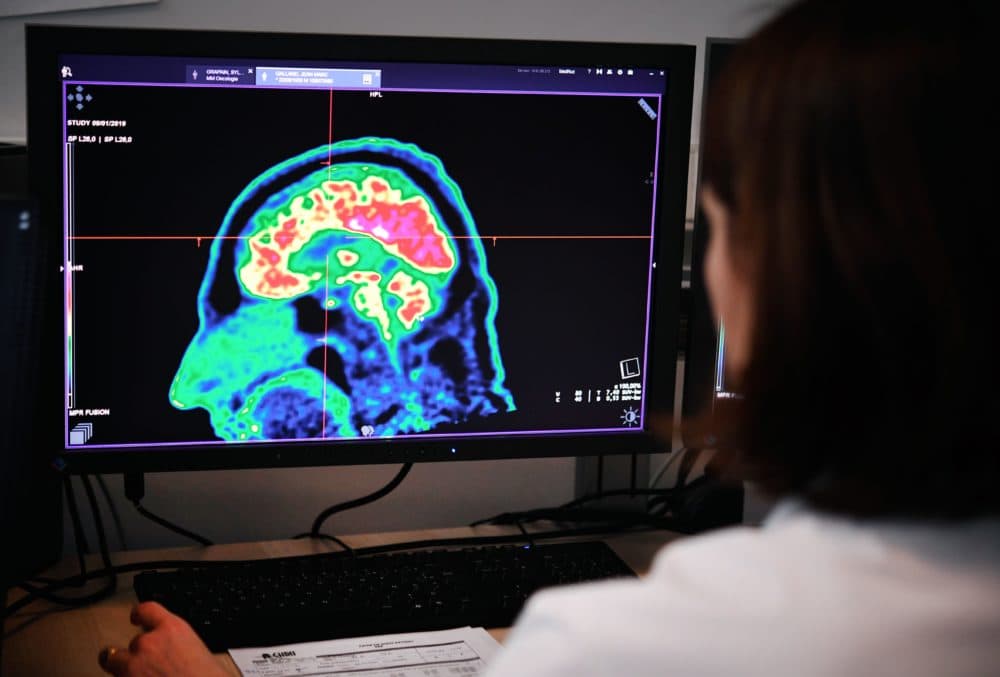
FELDMANHALL: Correct. So when the encephalon is assessing whether to make a decision, just as you did with me, whether you lot desire to trust me with a sum of coin, and whether I'g actually going to reciprocate it back, at that place's a region of the brain called the striatum. Information technology'south sort of nestled deep in the centre of the brain, and it's involved in advantage learning.
And then it uses rewards to learn about the globe. And what happened when you made that decision is that the striatum became active and it was 1 of the key regions that was making the conclusion to actually trust that $v with me.
CHAKRABARTI: Jamil, I have to say, money is kind of an interesting thing. I recollect I'll simply speaking for myself. My behavior when it comes to money is probably very different than my behavior if I just met a random person on the street and they were like, Hey, how's information technology going? You know, do you know what I hateful? Like, I retrieve I'one thousand more protective when information technology comes to coin and less trusting.
ZAKI: Yes, it'southward really interesting. I mean, the trust game that you just played is probably the workhorse of social scientific discipline, in agreement how people trust when they're willing to be vulnerable to somebody else, on the hope that that person will reciprocate, equally Oriel nicely said. But information technology's interesting because using coin to study trust is sort of like using money to written report kindness or other parts of our social lives. I mean, when we are friends with somebody, we don't just say, Oh, I can tell you're having a hard day. Hither'due south $5.
We back up each other. And when we trust somebody else, information technology'south not always by forking over a agglomeration of coin and seeing if they pay us back. Nosotros trust people to watch our kids. We trust people when nosotros confide in them. And at that place's at to the lowest degree some evidence that when you movement people, as you lot're saying, into the domain of money, they actually get-go acting differently.
They offset condign more calculative, even sometimes more selfish. And so we might, at the aforementioned time, realize that there's a lot of value in using games like the one that you just played. Simply there are limitations in understanding what social life is really like by just reducing it to money.
CHAKRABARTI: Okay, so that's an important caveat here. ... Now, Jamil, Oriel had talked near the striatum and advantage learning. ... Is it activated or is it agile when nosotros're building or demonstrating trust? What is actually happening in that office of the brain that generates what nosotros're experiencing every bit trust?
When we trust somebody else, it'southward non always past forking over a bunch of money and seeing if they pay us back.
ZAKI: Well, I recollect that as Oriel really put it very well, the striatum is a brain region or system in the brain that's associated with evaluating options. And in item, you can think of trust as a social risk. You put resources, time, energy into another person and then if all goes well, you lot end upwardly winning. In fact, you both end up winning. And it's not just with money. Of form, trust builds all sorts of other good things in our lives.
Only on the other side of that is the take chances of betrayal, which both tin be a monetary loss, just also can be an emotional loss if somebody hurts you or betrays your trust. And so the striatum is involved in assessing options that include chance. Then maybe computing, equally you were doing, Meghna. Saying, well, I don't know Oriel, but we are on the radio.
So in that location are some reasons peradventure to retrieve that she could just run away with the coin. But there are other reasons to call back that she wouldn't. When yous were evaluating the run a risk and likelihood, the ways that this gamble could plow out, that'southward a calculation that was occurring probable in office in your striatum.
CHAKRABARTI: And Oriel, we've got near a minute before we accept to take the first break. And so are there other parts of the encephalon that are of import here? I've been reading about the dorsomedial prefrontal cortex, which seems to come up up a lot when it comes to homo, particularly human behaviors.
FELDMANHALL: There's a network of brain regions really that are involved. Then the dorsomedial prefrontal cortex is one of those, and that is a key region for mentalizing or thinking nearly what another person will do, what are their intentions? How might they reciprocate the activity?
And so when yous are trying to appraise the risk, just as Jamil said, part of what you needed to do was to figure out what I was thinking. So this role of the encephalon sits right in a higher place your nose, right in your forehead.
But there'south also another region, the amygdala, which is, you know, probably a very famous region. People know a lot most it because it's almond shaped. It's on two sides of the brain and it'southward considered to be the threat or the fear center of the brain.
CHAKRABARTI: Jamil, Oriel was saying some really, really interesting things to me virtually the different parts of the brain that are associated or activated when nosotros're feeling trusted, or trusting someone. Because if I empathize correctly, we've got parts of the prefrontal cortex which are important to assess the world around usa. And make judgments. And then you also mentioned the amygdala, which is kind of a middle of elemental fight or flight beliefs.
And I know that I'm oversimplifying here, merely for the sake of time, ii really dissimilar parts of the brain here. But what'due south actually happening when we say these parts of the brain are being activated, is there some sort of surge in a neurotransmitter? Or what'southward going on?
ZAKI: Well, typically the studies that we're talking about now are functional magnetic resonance imaging studies, which really look at metabolism in the encephalon. So which parts of the brain are using oxygen in a particular moment, which neuroscientists then use equally a proxy for which parts of the brain are active. At present, exactly which neurotransmitters are involved is usually mysterious. If we're only using ephemera, there are other techniques that we would need to utilize to larn that, as well.
CHAKRABARTI: Oriel, when you mentioned reward being function of what's going on hither, in my layperson's understanding, my mind first went to dopamine, right? Because the whole idea of like that picayune dopamine squirt that we get sometimes when we experience like nosotros're winning or get a advantage. Is that function of the picture here at all?
FELDMANHALL: Yes. I mean, information technology is office of the movie. Nevertheless, equally Jamil said, it'south hard using just ... imaging techniques to understand the role of dopamine, specifically. And so for the most function, what neuroscientists are doing is looking at broad brush strokes, which regions of the encephalon are involved, like the striatum or the amygdala or the prefrontal cortex, and whether in that location's farther engagement.
Then that is just, every bit you said, surging action, which we telephone call the bold signal. And with more than current and cutting edge techniques, we can besides wait at how patterns of neural activity encode the things that Jamil was speaking about earlier, like risk cess. So not but about where and how strongly a region is involved, but what exactly that region is representing when it is engaged.
CHAKRABARTI: Okay. Then what'due south the significance of that? Help me understand more.
FELDMANHALL: Sure. And so people have different hazard profiles, but as you mentioned. And what nosotros could do by using these unlike types of techniques with imaging is to appraise what exactly your risk profile looks like in the brain. So if you take a pattern of activity in the striatum that is dissimilar than a pattern of action in my striatum, it might link to a chance profile that is, permit'south say, more risky than mine, which is more risk balky. And with these techniques, we can appraise those differences at the neuro level.
CHAKRABARTI: Okay. And then, yous know, it occurs to me that I'one thousand kind of interchanging when an private decides to trust someone else or an institution, and when someone feels trustworthy. At present there are 2 different things, correct?
Then I mean, Jamil, I was reading about how there were some early studies perhaps 15ish years ago that found that when someone feels trustworthy or someone else has demonstrated that they trust that person. So, like, if you lot showed me that you trusted me, that might generate a ascent in me, in oxytocin. So even only feeling trusted has some sort of effect on a person and their brain.
ZAKI: That's correct. And I think this brings us to a really important point. ... For example, when nosotros just played the trust game, you were focused on a couple of things, sort of, well, is this other person who I don't know, going to walk away with my money? Yous were thinking nigh, as virtually people practise, the vulnerability that trust gives united states of america. The way that when we trust somebody, we're putting something on the line. What I recollect we don't often realize enough is how much nosotros bear upon other people when nosotros make up one's mind whether or not to trust them.
So when you determine to trust somebody, you're sending a bespeak to them of who you lot think they are. And they're also receiving a indicate about who you lot are. That you're a social person who'south willing to invest in them. And it turns out that receiving that trust teaches people a lot and also makes them feel adept if they receive trust.
Which, as you said, is related to activity of oxytocin, simply too when people don't receive trust. If yous had sent $1 to Oriel, or nothing, well, so she would have maybe felt alienated. And it turns out that that's why people, or part of why people tend to reciprocate trust and retaliate against distrust. And so in improver to seeing trust equally a decision well-nigh whether we want to be vulnerable to somebody else, nosotros should run into it equally a decision to touch on somebody else, to be kind through our trust, or maybe to exist unkind through our distrust.
What I think we don't oftentimes realize plenty is how much we touch on other people when we determine whether or not to trust them.
CHAKRABARTI: So this is then fascinating to me considering, I mean, the mutual wisdom is that perhaps information technology's hard to build trust, just actually like shooting fish in a barrel to lose it. I mean, your case virtually the game is spot on. Because Oriel, I tin can only imagine how yous would experience if I just like, oh like I'll give you $0.50. Right?
Merely information technology would be similar the first real interaction between us. Nosotros don't know anything about each other, you know? And that one little determination that I'd make would have a major impact on how much you would cull to trust me in the future. I mean, is it really that that quick in terms of how people are judging others' trustworthiness?
FELDMANHALL: That's correct. And one of the things, you know, the sometime saying, just as you lot mentioned, it takes a while to build trust and it'south easy to lose it. If you make that initial step to non trust, or really to beguile the trust. Information technology makes it very difficult to come dorsum and build that trust again. And that's what nosotros call the sticky prior. And then yous accept this information that a person has betrayed you and it takes very a number of repeated experiences to push that bated and to start building trust over again.
The other thing is that people make decisions about how trustworthy an individual is just by looking at their confront. We don't take that ability because we're talking through the phone right at present in a podcast, but if nosotros were looking at one some other in forepart of each other, you and I would both make snap 2nd decisions or excuse me, judgments about how trustworthy we would look.
And those judgments about whether you look trustworthy or non are very predictive of important outcomes like elections, election success or prison house sentencing. And then there's a lot that goes into the equation of how we come up to trust another person.
CHAKRABARTI: Hang on here for simply a 2nd. I mean, yous're referencing studies that you've done, piece of work on this directly, that detect that we are looking at other people and making decisions about trustworthiness in milliseconds, right?
FELDMANHALL: That's correct. That'south right. Yes. And actually, not my piece of work. This is Alex Todorov. ... In milliseconds, essentially in 30 milliseconds, which is less than 1/10 of a second, people can brand these decisions nearly how trustworthy an individual looks.
CHAKRABARTI: What are they looking at that that gives them the data that they're processing in ane/10 of a second?
FELDMANHALL: Aye. So the whole face is basically captured. Merely what they're looking at is how far autonomously an individual'south eyes are, the luminance of their cheekbones, the widesetness of their jaw. This all gets taken in, in this very quick, automatic way in evaluated to render a decision of whether the person looks trustworthy, or whether they don't.
CHAKRABARTI: What about those factors makes us evolutionarily programed, to apply an awkward phrase, to recollect that sure things are more trustworthy than others?
FELDMANHALL: There's inefficiency in making these decisions. So if I meet you in a dark alley and everything that my brain says is that Meghna's not trustworthy. My amygdala is going to come online and tell me to turn around and run the other way. And that's an important thing to have in your toolkit, considering if you find yourself in a situation where yous are approaching threat or there's something that is threatening to you, yous need to eliminate it immediately. Then our bodies and our brains are wired, so to speak, to figure out those threatening situations very quickly and very swiftly.
CHAKRABARTI: So, Jamil, I have to say, this is actually, really compelling enquiry that Oriel is referencing here, information technology also makes me feel more than a little concerned. Because ... using her instance, if there were some brief millisecond interaction between Oriel and I, and her brain adamant that I was untrustworthy. So, therefore, is it that people who await like me would as well be untrustworthy? And if and then, I mean, I'1000 of, you lot know, Indian heritage. And so we'd be writing off more than a billion people here. I mean, I say that slightly natural language in cheek, but yous come across what I'chiliad getting at? It's worrisome, to say the least.
ZAKI: I do. I think Oriel just described this work beautifully, and it's really of import to empathize that our brains might accept these defaults. Simply just to say that we have these defaults is not the same as saying that they are correct in sometimes understanding when we might take instincts to trust or not trust people based on the manner that they look. Really, the style to use that information is to know that this might exist a bias that you have that's probably driving you in the incorrect direction a bunch of the time. And beingness aware of those biases can help.
Our bodies and our brains are wired, and so to speak, to figure out those threatening situations very quickly and very swiftly.
Y'all know, another general bias that we accept is just to not trust people enough, to exist cynical about whether people in full general, non just people who expect a certain way, but all people will reciprocate. And one of the catchy things about that is that information technology's very hard to learn based on non trusting somebody. So if nosotros trust someone and we're betrayed, nosotros learn, you know, it's takes years to earn that trust and seconds to lose information technology.
And we're always, you know, once burned, twice shy. But when nosotros don't trust somebody, nosotros can miss an opportunity. But those missed opportunities don't final in our memories the way that betrayal does. And as a result, we tend to exist too risk balky in the social world. We tend to be likewise amygdala-driven in our trust decisions, and nosotros lose out on opportunities. Not simply to, you lot know, make partnerships or collaborations, but to course and build relationships likewise.
CHAKRABARTI: You know, I understand how, let's say in early on human societies, this snap judgment literally of trustworthiness really makes some sense. Just of course, we're living in a very, very different world now, and especially in places like the United states, where nosotros are all the same working at trying to create, you know, this multi-ethnic democracy that relies fundamentally on trusting each other no matter who we are and what we expect like, in lodge to brand the country as a whole work. I mean, Jamil, just for a second hither, take this to the national level. What you and Oriel have been researching for all this time, how does it work when it comes to, let's say, how Americans trust each other?
ZAKI: Well, I recollect that we, I would contend, don't trust each other enough. If you lot ask people to guess how much a person will reciprocate in a trust game, they underestimated past about xxx%. And so we believe that people are less trustworthy than they really are. And I recollect that to your betoken, nosotros especially loathe to trust people who are different from ourselves in whatsoever number of ways, whether people who wait differently than us, people who identify differently, people who believe unlike things than we exercise.
And I think that those aboriginal instincts that, again, Oriel described really well might have served us in ancient times, but they're not ever serving united states of america now. And that lack of trust beyond difference can be an enormous barrier to collaboration between people, to friendships, and I would argue to democracy. Because once we offset to imagine that people we disagree with are only wholesale untrustworthy, that they're bad people, well, then nosotros forestall on any possibility of finding common footing.
CHAKRABARTI: Now, Oriel, your lab, I think I have this part correct, that your lab has found that because of these impulses that you talked about, we do tend to over generalize, like everybody does. Is that right?
FELDMANHALL: That's right. Then we did this study a number of years ago now where we had individuals play the game that you and I played. So substantially you could learn about individuals who were trustworthy and those who were untrustworthy. What we then did is we took the pictures of those individuals that they played with. So we were all looking at faces of the individuals, the partners, in the trust game.
But unbeknownst to our subjects, we morphed those people you learned that were trustworthy or untrustworthy, with dissimilar other people that they had never met before. And and then we said, Let'south play the trust game again with these individuals who had some resemblance. They had some parts of their faces that resembled those initial people that they learned were trustworthy, or who are not trustworthy.
And what we found was that initial learning of, allow's say, someone being trustworthy or untrustworthy, very much biased their decision to trust a completely novel, unfamiliar stranger. And so at that place's this perceptual similarity that what you're speaking about might non actually has a lot important for, allow's say, stereotype bias.
If yous accept one bad interaction or one good interaction with an individual who looks a certain way, you may then over generalize what that person looks like to people of the entire race and make judgments about whether they're trustworthy or untrustworthy based on that initial learned response from a previous interaction.
FELDMANHALL: So merely to be clear, I mean, we're non providing any kind of excuse here for racism, right? We're but trying to sympathise, y'all know, how the brain functions. But knowing what you know at present, Oriel. Nosotros've simply got a infinitesimal here before the adjacent break, and so I'll let yous starting time answering this. What should we do? How should nosotros change our own private behaviors to prevent ourselves from over generalizing?
FELDMANHALL: That's a tough but skilful question. I think there's a lot of automaticity that happens with overgeneralization. And again, it's an efficiency machinery that allows united states to come into a situation that might be threatening or aversive and walk away and thus preserve and begin to exist adaptive to our well-beingness.
Only the problem is, and Jamil mentioned this as well, is that our current society, the place that we live in the here and at present, is not built in the same fashion. And then if we have these impulses that rise up. Part of what we need to be doing is checking those impulses, thinking well-nigh them, and then evaluating to meet if they are actually correct or not.
CHAKRABARTI: Oriel and Jamil, I only want to share something that a listener had already sent to usa. It'southward a really interesting story from Lesley from Spokane, Washington. And she told united states near her human relationship with her friend Mandy.
LESLEY: We became fast, trigger-happy, best friends when we were 16 years onetime. And virtually six months later, I had to motility away. And we maintained our friendship from 300 miles autonomously. But equally we grew and as things started to change and she went off to college and I was however in high school, we started to abound apart and eventually a few things happened that acquired u.s. to totally lose trust in each other. And then we lost impact and nosotros didn't talk for about ten years.
CHAKRABARTI: So the relationship was completely broken. But after those ten years had passed, as Lesley was getting set up to motion beyond the country, she actually did something interesting. She reached out to Mandy even later a x year silence, to tell her that she missed her and that she hoped to restore their friendship.
LESLEY: So we came together, and we talked and nosotros shared how we both felt nigh what had happened in the past. Neither one of united states remembered all the details, and we didn't feel the demand to rehash the details either. All nosotros knew was that we loved each other and we missed each other and nosotros wanted to come back together. So to rebuild that trust did non take a whole lot of piece of work, actually. Simply one key matter that did happen is that Mandy and I apologized to each other.
CHAKRABARTI: Now there'southward a little more to this story. Merely Jamil, I simply wanted to hear your reaction to that, because I thought that was and so interesting, what Lesley said about how she and Mandy rebuilt their friendship.
ZAKI: I love that story. And, you know, I think that it speaks to a couple of themes that y'all see in the scientific discipline of trust and in the sociology of it likewise. I hateful, the first is that after trust is lost, information technology's easy to assume that a relationship is over forever. And again, nosotros tend to be adventure averse to phone call somebody upward after ten years and say, yous know, I'grand deplorable most what happened. That takes a lot of run a risk. That's a lot of work. And if somebody rejects you lot, it could be enormously painful.
Simply a lot of research suggests that, in fact, we overestimate the risks and underestimate the benefits of taking those chances on people. At that place'due south a bunch of work that shows that when people imagine reaching out to somebody, either somebody new or somebody possibly in their life who they haven't talked with in a while, they overestimate how awkward it volition be, how likely information technology will be that the person will judge them, and they underestimate how likely it will be that the interaction will be positive and fulfilling.
A lot of enquiry suggests that, in fact, we overestimate the risks and underestimate the benefits of taking those chances on people.
And in this case, thankfully, Lesley took this chance. And Mandy, these ii took this run a risk on each other and realized that, in fact, you lot know, at that place was a lot of beloved however there.
CHAKRABARTI: Yeah, this is a recurrent theme. And every fourth dimension we learn more than about the encephalon or guests come on the show about whatsoever neurological topic, people are really bad at estimating things. But, you know, 1 detail in Lesley's story really stands out to me when she said after she reconnected with Mandy afterwards x years, she said, neither of united states remembered all the details about what had happened in the past, and nosotros didn't feel the need to rehash the details either. Is that significant?
FELDMANHALL: I mean, it speaks very well of their ability to rekindle their human relationship. And I recollect, y'all know, retentiveness is a fallible system. Nosotros don't have these perfect filing systems for what happened. There is no verticality for the history, the postage stamp of history. And so our brains do a lot to reinterpret those memories in the context of what's important to us now when they rekindle that relationship.
I of the things that the inquiry shows is that trusting another person in an unconditional way feels really proficient. The part of the brain that encodes positive and dotted experiences lights up with these unconditional, trusting moments. And what was probably happening in that location when they rekindled their relationship is that parts of the brain were lighting upward. That made it feel actually skilful between them, and that helped be the social glue that was of import to carry on their friendship.
CHAKRABARTI: Yes. And so this takes united states of america to the last part of Lesley's story, because she also told us that since she and Mandy reconnected and critically, every bit she said, apologized to each other, their relationship has go essential in Lesley'south life.
Trusting another person in an unconditional way feels actually expert.
LESLEY: Mandy and I are now incredibly shut. We talk nearly every day. We share our lives together, even though we live ii,000 miles apart. And the trust that I have in her is greater than anyone else in my life too my hubby.
CHAKRABARTI: So that'due south Lesley from Spokane, Washington. Jamil, selection up on what Oriel was saying about what are the measurable benefits of having trust in others.
ZAKI: Information technology's enormous. I mean, you tin recall of trust as the kind of grease in our social engine that just makes social life work. And that's at a number of unlike levels. One is when we have trusting relationships that bolsters the states as individuals, information technology improves our mental wellness and our physical health as well. People who feel as though they tin trust the folks in their lives tend to alive longer.
They're less probable to die from eye affliction, for instance, than those who feel like they can't trust other people. But trust also is the grease in our national social engines. So, for instance, countries that have greater interpersonal trust tend to flourish economically compared to those that don't. And that'south the good news. The bad news is that if trust is this precious natural resources, it'due south endangered.
So in 1972, virtually half of Americans agreed that virtually people can be trusted. Only by 2018, that had fallen to most 30%. We trust institutions far less than we did 50 years agone. So, for instance, in 1970, 80% of Americans trusted the medical system. Now it'due south 38%. Telly news in the 1970s was 46%. At present it'south 11%. Congress, 42% to vii%. We are living through a massive trust recession and that is pain us in a number of ways that probably most people are totally unaware of.
We trust institutions far less than we did 50 years ago.
CHAKRABARTI: What's driving this, Jamil? I hateful, I take my own theories, just what do you retrieve is driving this trust recession?
ZAKI: Well, it'southward hard to know because history is not an experiment. Yous can't run it a bunch of different times and tinker with different factors and show which one causes a reduction in trust. Only a couple of things pop out. Yous know, 1 is that we set highly unequal societies, whether it'southward communities, towns, states or countries tend to be lower in social trust when there are high profile examples of abuse that also tin can damage trust in a population for a long time.
But another thing gets back to what we were talking virtually before with coin. So when people feel like they're in competition with one another, when they're counting what they accept and comparing it to what the person next to them has, it's harder for people in those zero-sum contexts to build trust.
Well, I would speculate ... that a lot more of our lives are comparable than they used to exist. And then I used to maybe know if someone'southward house was bigger than mine, just at present I also know whether they are taking more steps than I exercise, whether they're meditating more, whether they're getting more than likes on social media. And I think that that comparative mindset might not be bully for trust either.
A lot more than of our lives are comparable than they used to be.
CHAKRABARTI: Oriel, I'thou thinking about the research that you've done about overgeneralization and that, yous know, the facial millisecond judgments that we're making. I mean, information technology as well seems to me that maybe our national trust recession has been the directly result of political and media manipulation. Because, I mean, if it's so easy to lose trust in other groups of people, I don't think the way the media is correct now or even our political civilization is helping us build trust in each other.
FELDMANHALL: I recall that's correct. I call back it'southward a ii-way street. And I think that y'all expect at the way that, for case, the media approached politics 50 years agone and there were dimensions and domains that the media wouldn't affect, let's say, when interviewing a president. That is no longer the case. It'due south sort of every aspect of a person's life is allowed to be exploited and probed and investigated on. And that has repercussions for what we know nigh politicians, for Congress, for the constabulary force, and so on and and then forth.
You know, this is just a speculation, but I wonder if the trust recession that we're seeing on a national level isn't funneled into a different outlet, which is a more core familial blazon of trust. So taking our trust away from institutions and funneling it into a smaller circle of friends and family, and you might see that in echo chambers, for case, on Twitter or on Facebook or in social media, where you surround yourself with people who agree with what you believe, certainly on a political level.
CHAKRABARTI: Well, you know, speaking of institutions, though, in trying to understand the neurobiology of trust, information technology but occurs to me that well-nigh of the conversation that the three of united states accept had has been like how we experience in our brain trust of other individuals. But does the aforementioned sort of brain activity come into play when nosotros're talking about trusting institutions?
FELDMANHALL: It is, yes. Just the fashion you and I started off this hour by playing the trust game, but nosotros're not looking at each other. We tin make these decisions nigh trust without having some face in front end of us or without looking into each other's eyes. And that's exactly what happens on an abstruse level when you're thinking near institutions or unlike political groups or, you lot know, the constabulary or whatever it might be.
You tin can abstract away from looking at a item face up or thinking about a particular confront and make these types of trust judgments on a much higher level.
CHAKRABARTI: Okay. So, Jamil, this makes me wonder, every time we talk about the brain, I feel myself balancing on this knife's edge about like, okay, how much of my life is, is being governed by evolution and instinct versus how much tin can I really modify that to actually, you know, fit the times that we're living in? I guess this is the same question I asked Oriel earlier, simply I'd love to hear sort of your toolkit here. For people listening to this hour, what would you recommend they practice in order to maximize the benefits in their ain lives of trusting others?
ZAKI: It's a great question, Meghna. And you lot know, I want to get back to something that Oriel said, which is that we are sort of wired in particular ways perchance to exist take chances averse and maybe to be especially risk averse when people don't look similar us, or recollect similar us, or talk like us because we worry that they might betray our trust, we might be wired that manner.
Just I would argue that the brain is non hard wired, that it'due south soft wired, and that only because we have some ancient instinct doesn't mean that nosotros have to succumb to that instinct and say, Well, I judge that'south merely who I am. We can take control of our instincts and reflect on them and be intentional. And so I guess what I would propose to listeners is when you are considering whether to trust somebody or an institution, perchance exist aware that yous might have as well much of an amygdala driven perspective to start out with.
Y'all might be overestimating the risk and underestimating the benefit. You might be relying on biases, maybe biases that you lot aren't aware of correct abroad only can become enlightened of. And what are the things that yous might consider is whether you lot might take a gamble on somebody, examination the waters a piddling bit more than you are.
Just because we take some ancient instinct, doesn't mean that we have to succumb to that instinct.
And I think what the bear witness tells us is that when people practice that, they're often quite surprised, quite positively surprised by how trustworthy and giving other people are past how much they want to connect. But like the story that you shared with us of those two friends from Spokane and how much trusting somebody really leads to all sorts of hidden rewards in our lives that we would otherwise miss if we were as well fearful.
Source: https://www.wbur.org/onpoint/2022/11/29/essential-trust-how-our-brains-process-trust
0 Response to "How Our Brains Decide When To Trust"
Post a Comment