

A Bird Without Wings Meaning
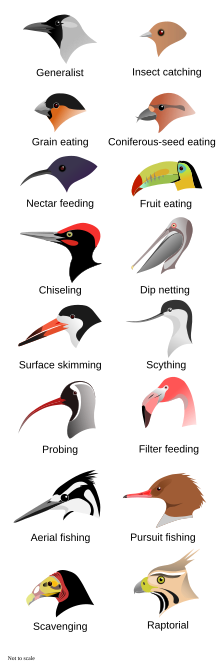
Comparison of bird beaks, displaying different shapes adapted to different feeding methods. Not to scale.
The pecker, bill, or rostrum is an external anatomical structure constitute mostly in birds, but also in turtles, not-avian dinosaurs and a few mammals. A beak is used for eating, preening, manipulating objects, killing casualty, fighting, probing for nutrient, courtship, and feeding young. The terms beak and rostrum are also used to refer to a like mouth part in some ornithischians, pterosaurs, cetaceans, dicynodonts, anuran tadpoles, monotremes (i.e. echidnas and platypuses, which have a beak-like construction), sirens, pufferfish, billfishes and cephalopods.
Although beaks vary significantly in size, shape, color and texture, they share a similar underlying structure. Two bony projections – the upper and lower mandibles – are covered with a sparse keratinized layer of epidermis known as the rhamphotheca. In nearly species, two holes called nares lead to the respiratory organization.
Etymology [edit]
Although the word "beak" was, in the past, generally restricted to the sharpened bills of birds of casualty,[i] in mod ornithology, the terms nib and neb are generally considered to exist synonymous.[2] The word, which dates from the 13th century, comes from the Middle English bec, which itself comes from the Latin beccus.[iii]
Anatomy [edit]

The bony cadre of the beak is a lightweight framework, like that seen on this barn owl's skull.
Although beaks vary significantly in size and shape from species to species, their underlying structures have a like pattern. All beaks are equanimous of two jaws, generally known every bit the upper mandible (or maxilla) and lower mandible (or mandible).[4] (p147) The upper, and in some cases the lower, mandibles are strengthened internally by a circuitous three-dimensional network of bony spicules (or trabeculae) seated in soft connective tissue and surrounded by the difficult outer layers of the pecker.[5] (p149) [six] The avian jaw apparatus is made upward of ii units: 1 four-bar linkage mechanism and one five-bar linkage mechanism.[vii]
Mandibles [edit]

A gull'southward upper mandible can flex upwards because it is supported past small bones which can motion slightly backwards and forwards.
The upper mandible is supported by a three-pronged bone chosen the intermaxillary. The upper prong of this bone is embedded into the forehead, while the two lower prongs attach to the sides of the skull. At the base of the upper mandible a thin sheet of nasal bones is fastened to the skull at the nasofrontal hinge, which gives mobility to the upper mandible, assuasive it to motility upwards and downwards.[2]
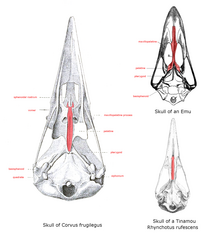
Position of vomer (shaded blood-red) in neognathae (left) and paleognathae (right)
The base of the upper mandible, or the roof when seen from the mouth, is the palate, the construction of which differs greatly in the ratites. Here, the vomer is large and connects with premaxillae and maxillopalatine bones in a condition termed equally a "paleognathous palate". All other extant birds have a narrow forked vomer that does not connect with other bones and is then termed as neognathous. The shape of these basic varies across the bird families.[a]
The lower mandible is supported by a bone known equally the inferior maxillary bone—a compound os composed of 2 distinct ossified pieces. These ossified plates (or rami), which can be U-shaped or V-shaped,[4] (p147) join distally (the verbal location of the articulation depends on the species) just are separated proximally, attaching on either side of the head to the quadrate bone. The jaw muscles, which allow the bird to shut its beak, attach to the proximal end of the lower mandible and to the bird's skull.[v] (p148) The muscles that depress the lower mandible are unremarkably weak, except in a few birds such equally the starlings and the extinct Huia, which have well-adult digastric muscles that aid in foraging past prying or gaping actions.[8] In most birds, these muscles are relatively small equally compared to the jaw muscles of similarly sized mammals.[nine]
Rhamphotheca [edit]
The outer surface of the bill consists of a thin sheath of keratin called the rhamphotheca,[2] [v] (p148) which can be subdivided into the rhinotheca of the upper mandible and the gnathotheca of the lower mandible.[10] (p47) This covering arises from the Malpighian layer of the bird's epidermis,[x] (p47) growing from plates at the base of operations of each mandible.[xi] At that place is a vascular layer between the rhamphotheca and the deeper layers of the dermis, which is attached directly to the periosteum of the bones of the beak.[12] The rhamphotheca grows continuously in well-nigh birds, and in some species, the color varies seasonally.[xiii] In some alcids, such as the puffins, parts of the rhamphotheca are shed each year after the breeding flavor, while some pelicans shed a part of the bill chosen a "bill horn" that develops in the breeding season.[14] [15] [16]
While most extant birds have a unmarried seamless rhamphotheca, species in a few families, including the albatrosses[10] (p47) and the emu, accept compound rhamphothecae that consist of several pieces separated and defined by softer keratinous grooves.[17] Studies accept shown that this was the archaic ancestral state of the rhamphotheca, and that the mod simple rhamphotheca resulted from the gradual loss of the defining grooves through evolution.[18]
Tomia [edit]

The sawtooth serrations on a common merganser'southward bill help it to hold tight to its fish casualty.
The tomia (singular tomium) are the cutting edges of the ii mandibles.[10] (p598) In most birds, these range from rounded to slightly precipitous, merely some species have evolved structural modifications that permit them to handle their typical food sources better.[xix] Granivorous (seed-eating) birds, for instance, take ridges in their tomia, which help the bird to slice through a seed's outer hull.[20] Nearly falcons have a sharp projection along the upper mandible, with a respective notch on the lower mandible. They apply this "tooth" to sever their casualty's vertebrae fatally or to rip insects apart. Some kites, principally those that prey on insects or lizards, too have one or more of these sharp projections,[21] every bit do the shrikes.[22] The tomial teeth of falcons are underlain by bone, while the shrike tomial teeth are entirely keratinous.[23] Some fish-eating species, due east.g., the mergansers, have sawtooth serrations along their tomia, which assist them to proceed hold of their slippery, wriggling prey.[10] (p48)
Birds in roughly 30 families take tomia lined with tight bunches of very short bristles along their entire length. Almost of these species are either insectivores (preferring hard-shelled prey) or snail eaters, and the brush-like projections may assist to increase the coefficient of friction between the mandibles, thereby improving the bird'due south ability to agree hard prey items.[24] Serrations on hummingbird bills, found in 23% of all hummingbird genera, may perform a similar function, allowing the birds to finer concur insect casualty. They may besides allow shorter-billed hummingbirds to office as nectar thieves, as they tin more than effectively hold and cut through long or waxy flower corollas.[25] In some cases, the colour of a bird's tomia can help to distinguish between similar species. The snow goose, for example, has a reddish-pink nib with black tomia, while the whole nib of the similar Ross's goose is pink-ruddy, without darker tomia.[26]
Culmen [edit]

A bird'due south culmen is measured in a direct line from the tip of the beak to a fix betoken — here, where the feathering starts on the bird's brow.[27]
The culmen is the dorsal ridge of the upper mandible.[10] (p127) Likened by ornithologist E. Coues[4] to the ridge line of a roof, it is the "highest heart lengthwise line of the bill" and runs from the bespeak where the upper mandible emerges from the brow'southward feathers to its tip.[4] (p152) The bill's length forth the culmen is one of the regular measurements made during bird banding (ringing)[27] and is especially useful in feeding studies.[28] There are several standard measurements that tin be made—from the beak's tip to the bespeak where feathering starts on the forehead, from the tip to the inductive border of the nostrils, from the tip to the base of the skull, or from the tip to the cere (for raptors and owls)[10] (p342) — and scientists from various parts of the world generally favor one method over another.[28] In all cases, these are chord measurements (measured in a straight line from point to point, ignoring whatever bend in the culmen) taken with calipers.[27]
The shape or color of the culmen can also help with the identification of birds in the field. For example, the culmen of the parrot crossbill is strongly decurved, while that of the very like red crossbill is more than moderately curved.[29] The culmen of a juvenile common loon is all dark, while that of the very similarly plumaged juvenile yellow-billed loon is pale towards the tip.[thirty]
Gonys [edit]
The gonys is the ventral ridge of the lower mandible, created by the junction of the bone's two rami, or lateral plates.[ten] (p254) The proximal end of that junction — where the ii plates separate—is known as the gonydeal angle or gonydeal expansion. In some gull species, the plates expand slightly at that betoken, creating a noticeable bulge; the size and shape of the gonydeal bending can be useful in identifying between otherwise like species. Adults of many species of big gulls take a ruddy or orange gonydeal spot near the gonydeal expansion.[31] This spot triggers begging behavior in dupe chicks. The chick pecks at the spot on its parent's beak, which in turn stimulates the parent to regurgitate food.[32]
Commissure [edit]
Depending on its utilise, commissure may refer to the junction of the upper and lower mandibles,[4] (p155) or alternately, to the full-length apposition of the closed mandibles, from the corners of the rima oris to the tip of the beak.[ten] (p105)
Gape [edit]

The gapes of juvenile altricial birds are often brightly coloured, every bit in this common starling.
In bird anatomy, the gape is the interior of the open rima oris of a bird, and the gape flange is the region where the two mandibles join together at the base of the beak.[33] The width of the gape tin be a factor in the choice of food.[34]
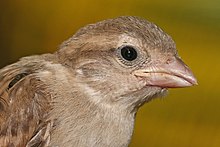
The gape flange on this juvenile house sparrow is the yellowish region at the base of operations of the bill.
Gapes of juvenile altricial birds are often brightly coloured, sometimes with contrasting spots or other patterns, and these are believed to be an indication of their health, fitness and competitive ability. Based on this, the parents make up one's mind how to distribute nutrient among the chicks in the nest.[35] Some species, particularly in the families Viduidae and Estrildidae, accept vivid spots on the gape known as gape tubercles or gape papillae. These nodular spots are conspicuous even in low light.[36] A report examining the nestling gapes of viii passerine species establish that the gapes were conspicuous in the ultraviolet spectrum (visible to birds just not to humans).[37] Parents may, however, not rely solely on the gape coloration, and other factors influencing their decision remain unknown.[38]
Red gape color has been shown in several experiments to induce feeding. An experiment in manipulating brood size and allowed system with befouled swallow nestlings showed the vividness of the gape was positively correlated with T-cell–mediated immunocompetence, and that larger brood size and injection with an antigen led to a less bright gape.[39] Conversely, the ruby-red gape of the common cuckoo (Cuculus canorus) did not induce extra feeding in host parents.[forty] Some breed parasites, such every bit the Hodgson'due south militarist-cuckoo (C. fugax), have colored patches on the fly that mimic the gape color of the parasitized species.[41]
When born, the chick's gape flanges are fleshy. As it grows into a fledgling, the gape flanges remain somewhat swollen and tin can thus exist used to recognize that a particular bird is young.[42] By the time it reaches machismo, the gape flanges will no longer be visible.
Nares [edit]

Most species of birds accept external nares (nostrils) located somewhere on their bill. The nares are two holes—circular, oval or slit-like in shape—which lead to the nasal cavities within the bird'southward skull, and thus to the rest of the respiratory arrangement.[10] (p375) In nigh bird species, the nares are located in the basal third of the upper mandible. Kiwi are a notable exception; their nares are located at the tip of their bills.[19] A handful of species take no external nares. Cormorants and darters take primitive external nares every bit nestlings, but these close shortly after the birds fledge; adults of these species (and gannets and boobies of all ages, which also lack external nostrils) breathe through their mouths.[ten] (p47) At that place is typically a septum made of bone or cartilage that separates the 2 nares, but in some families (including gulls, cranes and New World vultures), the septum is missing.[10] (p47) While the nares are uncovered in nigh species, they are covered with feathers in a few groups of birds, including grouse and ptarmigans, crows, and some woodpeckers.[10] (p375) The feathers over a ptarmigan's nostrils aid to warm the air it inhales,[44] while those over a woodpecker's nares help to keep woods particles from bottleneck its nasal passages.[45]
Species in the bird lodge Procellariformes accept nostrils enclosed in double tubes which sit atop or along the sides of the upper mandible.[10] (p375) These species, which include the albatrosses, petrels, diving petrels, storm petrels, fulmars and shearwaters, are widely known as "tubenoses".[46] A number of species, including the falcons, take a pocket-sized bony tubercule which projects from their nares. The function of this tubercule is unknown. Some scientists suggest it may deed equally a baffle, slowing down or diffusing airflow into the nares (and thus assuasive the bird to go on animate without damaging its respiratory organisation) during high-speed dives, but this theory has non been proved experimentally. Not all species that fly at high speeds have such tubercules, while some species which wing at depression speeds practise.[43]
Operculum [edit]

The rock dove'due south operculum is a mass at the base of the bill.
The nares of some birds are covered past an operculum (plural opercula), a membraneous, horny or cartilaginous flap.[five] (p117) [47] In diving birds, the operculum keeps water out of the nasal cavity;[v] (p117) when the birds swoop, the affect force of the h2o closes the operculum.[48] Some species which feed on flowers have opercula to assistance to proceed pollen from bottleneck their nasal passages,[five] (p117) while the opercula of the two species of Attagis seedsnipe assistance to keep dust out.[49] The nares of nestling tawny frogmouths are covered with big dome-shaped opercula, which help to reduce the rapid evaporation of water vapor, and may also help to increment condensation within the nostrils themselves—both disquisitional functions, since the nestlings get fluids only from the food their parents bring them. These opercula shrink every bit the birds age, disappearing completely by the time they reach adulthood.[50] In pigeons, the operculum has evolved into a soft swollen mass that sits at the base of the bill, above the nares;[10] (p84) though it is sometimes referred to as the cere, this is a unlike structure.[4] (p151) Tapaculos are the only birds known to have the ability to move their opercula.[x] (p375)
Rosette [edit]
Some species, such as the puffin, have a fleshy rosette, sometimes chosen a "gape rosette",[51] at the corners of the beak. In the puffin, this is grown as part of its display plumage.[52]
Cere [edit]
Birds from a handful of families—including raptors, owls, skuas, parrots, turkeys and curassows—have a waxy structure called a cere (from the Latin cera, which ways "wax") or ceroma [53] [54] which covers the base of their nib. This structure typically contains the nares, except in the owls, where the nares are distal to the cere. Although it is sometimes feathered in parrots,[55] the cere is typically bare and frequently brightly colored.[nineteen] In raptors, the cere is a sexual betoken which indicates the "quality" of a bird; the orangeness of a Montagu's harrier'south cere, for example, correlates to its body mass and concrete condition.[56] The cere color of young Eurasian scops-owls has an ultraviolet (UV) component, with a UV acme that correlates to the bird'southward mass. A chick with a lower body mass has a UV peak at a higher wavelength than a chick with a higher body mass does. Studies take shown that parent owls preferentially feed chicks with ceres that show higher wavelength UV peaks, that is, lighter-weight chicks.[57]
The color or appearance of the cere can be used to distinguish between males and females in some species. For example, the male bully curassow has a yellow cere, which the female (and young males) lack.[58] The male person budgerigar's cere is royal blue, while the female person's is a very pale blueish, white, or brown.[59]
Nail [edit]
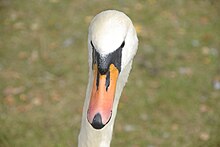
The boom is the blackness tip of this mute swan'southward bill.
All birds of the family Anatidae (ducks, geese, and swans) have a boom, a plate of hard horny tissue at the tip of the nib.[sixty] This shield-shaped structure, which sometimes spans the entire width of the pecker, is often bent at the tip to form a hook.[61] Information technology serves different purposes depending on the bird's primary food source. Virtually species apply their nails to dig seeds out of mud or vegetation,[62] while diving ducks apply theirs to pry molluscs from rocks.[63] At that place is evidence that the nail may help a bird to grasp objects. Species which employ strong grasping motions to secure their food (such equally when catching and property onto a big squirming frog) have very broad nails.[64] Certain types of mechanoreceptors, nerve cells that are sensitive to pressure level, vibration, or affect, are located under the nail.[65]
The shape or color of the boom tin sometimes be used to help distinguish between like-looking species or between various ages of waterfowl. For example, the greater scaup has a wider black blast than does the very similar lesser scaup.[66] Juvenile "gray geese" have nighttime nails, while most adults have pale nails.[67] The blast gave the wildfowl family 1 of its former names: "Unguirostres" comes from the Latin ungus, pregnant "nail" and rostrum, pregnant "bill".[61]
Rictal bristles [edit]
Rictal beard are stiff hair-like feathers that ascend around the base of the beak.[68] They are common among insectivorous birds, but are also found in some not-insectivorous species.[69] Their office is uncertain, although several possibilities have been proposed.[68] They may function as a "net", helping in the capture of flight prey, although to date, at that place has been no empirical bear witness to support this idea.[70] In that location is some experimental evidence to advise that they may prevent particles from striking the eyes if, for example, a prey item is missed or broken apart on contact.[69] They may also assist to protect the optics from particles encountered in flying, or from coincidental contact from vegetation.[70] There is besides evidence that the rictal bristles of some species may function tactilely, in a manner similar to that of mammalian whiskers (vibrissae). Studies have shown that Herbst corpuscles, mechanoreceptors sensitive to pressure level and vibration, are plant in association with rictal beard. They may aid with prey detection, with navigation in darkened nest cavities, with the gathering of information during flight or with prey handling.[70]
Egg tooth [edit]
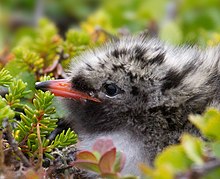
This Arctic tern chick nevertheless has its egg tooth, the small-scale white projection well-nigh the tip of its upper mandible.
Full-term chicks of most bird species take a pocket-sized sharp, calcified project on their beak, which they apply to chip their style out of their egg.[10] (p178) Commonly known as an egg tooth, this white spike is mostly virtually the tip of the upper mandible, though some species have one near the tip of their lower mandible instead, and a few species have one on each mandible.[71] Despite its name, the projection is not an actual molar, as the similarly-named projections of some reptiles are; instead, it is role of the integumentary organization, as are claws and scales.[72] The hatching chick get-go uses its egg tooth to pause the membrane around an air bedroom at the wide terminate of the egg. Then information technology pecks at the eggshell while turning slowly within the egg, eventually (over a period of hours or days) creating a serial of modest circular fractures in the crush.[5] (p427) Once information technology has breached the egg'due south surface, the chick continues to chip at it until information technology has made a large pigsty. The weakened egg somewhen shatters under the pressure level of the bird's movements.[5] (p428)
The egg tooth is and so critical to a successful escape from the egg that chicks of most species will perish unhatched if they neglect to develop one.[71] Yet, there are a few species which do not have egg teeth. Megapode chicks take an egg molar while all the same in the egg but lose it before hatching,[v] (p427) while kiwi chicks never develop ane; chicks of both families escape their eggs by kicking their way out.[73] Virtually chicks lose their egg teeth within a few days of hatching,[10] (p178) though petrels keep theirs for nearly iii weeks[v] (p428) and marbled murrelets have theirs for up to a month.[74] Generally, the egg molar drops off, though in songbirds information technology is reabsorbed.[5] (p428)
Colour [edit]
The colour of a bird'south beak results from concentrations of pigments — primarily melanins and carotenoids — in the epidermal layers, including the rhamphotheca.[75] Eumelanin, which is found in the blank parts of many bird species, is responsible for all shades of grayness and black; the denser the deposits of pigment found in the epidermis, the darker the resulting color. Phaeomelanin produces "world tones" ranging from gilded and rufous to diverse shades of brown.[76] : 62 Although it is thought to occur in combination with eumelanin in beaks whfich are buff, tan, or horn-colored, researchers have nonetheless to isolate phaeomelanin from any pecker structure.[76] : 63 More than a dozen types of carotenoids are responsible for the coloration of most red, orangish, and yellow beaks.[76] : 64
The hue of the color is determined by the precise mix of ruby-red and xanthous pigments, while the saturation is determined by the density of the deposited pigments. For example, bright red is created by dense deposits of mostly red pigments, while ho-hum yellow is created by diffuse deposits of generally yellowish pigments. Brilliant orangish is created past dumbo deposits of both reddish and yellow pigments, in roughly equal concentrations.[76] : 66 Beak coloration helps to make displays using those beaks more obvious.[77] (p155) In general, nib color depends on a combination of the bird's hormonal land and diet. Colors are typically brightest as the breeding flavour approaches, and palest after breeding.[31]
Birds are capable of seeing colors in the ultraviolet range, and some species are known to have ultraviolet peaks of reflectance (indicating the presence of ultraviolet colour) on their beaks.[78] The presence and intensity of these peaks may indicate a bird's fitness,[56] sexual maturity or pair bond status. [78] King and emperor penguins, for case, show spots of ultraviolet reflectance only as adults. These spots are brighter on paired birds than on courting birds. The position of such spots on the beak may be important in allowing birds to identify conspecifics. For example, the very similarly-plumaged king and emperor penguins have UV-cogitating spots in different positions on their beaks.[78]
Dimorphism [edit]
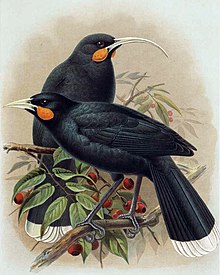
The beaks of the now-extinct Huia (female person upper, male lower) prove marked sexual dimorphism
The size and shape of the beak can vary across species besides as between them; in some species, the size and proportions of the nib vary betwixt males and females. This allows the sexes to utilize different ecological niches, thereby reducing intraspecific competition.[79] For example, females of nearly all shorebirds accept longer bills than males of the same species,[80] and female American avocets have beaks which are slightly more upturned than those of males.[81] Males of the larger dupe species have bigger, stouter beaks than those of females of the same species, and immatures can have smaller, more than slender beaks than those of adults.[82] Many hornbills show sexual dimorphism in the size and shape of both beaks and casques, and the female huia's slim, decurved neb was near twice as long every bit the male'southward straight, thicker one.[10] (p48)
Color can as well differ betwixt sexes or ages inside a species. Typically, such a color difference is due to the presence of androgens. For example, in house sparrows, melanins are produced only in the presence of testosterone; castrated male house sparrows—like female business firm sparrows—accept chocolate-brown beaks. Castration also prevents the normal seasonal color change in the beaks of male black-headed gulls and indigo buntings.[83]
Development [edit]
The beak of modernistic birds has a fused premaxillary bone, which is modulated by the expression of Fgf8 gene in the frontonasal ectodermal zone during embryonic development.[84]
The shape of the beak is determined by two modules: the prenasal cartilage during early embryonic phase and the premaxillary bone during later on stages. Development of the prenasal cartilage is regulated past genes Bmp4 and CaM, while that of the premaxillary os is controlled past TGFβllr, β-catenin, and Dickkopf-iii. [85] [86] TGFβllr codes for a serine/threonine poly peptide kinase that regulates gene transcription upon ligand bounden; previous work has highlighted its office in mammalian craniofacial skeletal development.[87] β-catenin is involved in the differentiation of last bone cells. Dickkopf-3 codes for a secreted poly peptide also known to exist expressed in mammalian craniofacial development. The combination of these signals determines beak growth along the length, depth, and width axes. Reduced expression of TGFβllr significantly decreased the depth and length of chicken embryonic beak due to the underdevelopment of the premaxillary bone.[88] Contrarily, an increase in Bmp4 signaling would outcome in a reduced premaxillary bone due to the overdevelopment of the prenasal cartilage, which takes up more than mesenchymal cells for cartilage, instead of bone, formation.[85] [86]
Functions [edit]
Three barn owls threatening an intruder. Befouled owl threat displays ordinarily include hissing and bill-snapping, as here

The platypus uses its bill to navigate underwater, discover nutrient, and dig. The beak contains receptors that help observe prey.
Birds may seize with teeth or stab with their beaks to defend themselves.[89] Some species use their beaks in displays of various sorts. As part of his courtship, for case, the male garganey touches his beak to the blue speculum feathers on his wings in a fake preening brandish, and the male Mandarin duck does the aforementioned with his orangish canvass feathers.[77] (p20) A number of species use a gaping, open nib in their fear and/or threat displays. Some augment the display past hissing or breathing heavily, while others clap their nib. The platypus uses its pecker to navigate underwater, discover food, and dig. The neb contains electroreceptors and mechanoreceptors, causing muscular contractions to aid find prey. It is one of the few species of mammals to use electroreception.[xc] [91]
Preening [edit]
The beak of birds plays a office in removing skin parasites (ectoparasites) such every bit lice. It is mainly the tip of the beak that does this. Studies accept shown that inserting a bit to stop birds from using the tip results in increased parasite loads in pigeons.[92] Birds that take naturally deformed beaks have also been noted to have higher levels of parasites.[93] [94] [95] [96] It is thought that the overhang at the end of the elevation portion of the beak (that is the portion that begins to curve downwards) slides against the lower beak to crush parasites.[92]
This overhang of the beak is thought to be under stabilising natural option. Very long beaks are thought to be selected against because they are prone to a higher number of breaks, equally has been demonstrated in rock pigeons.[97] Beaks with no overhang would be unable to effectively remove and impale ectoparasites as mentioned in a higher place. Studies have supported in that location is a selection force per unit area for an intermediate amount of overhang. Western Scrub Jays who had more symmetrical bills (i.eastward. those with less of an overhang), were found to take higher amounts of lice when tested.[98] The same pattern has been seen in surveys of Peruvian birds.[99]
Additionally, because of the part beaks play in preening, this is bear witness for coevolution of the neb overhang morphology and body morphology of parasites. Artificially removing the ability to preen in birds, followed by readdition of preening ability was shown to result in changes in body size in lice. Once the ability of the birds to preen was reintroduced, the lice were institute to evidence declines in body size suggesting they may evolve in response to preening pressures from birds[92] who could respond in turn with changes in beak morphology.[92]
Communication [edit]
A number of species, including storks, some owls, frogmouths and the noisy miner, use bill clapping as a class of communication.[77] (p83)
Heat exchange [edit]
Studies have shown that some birds use their beaks to rid themselves of backlog estrus. The toco toucan, which has the largest beak relative to the size of its body of whatsoever bird species, is capable of modifying the blood catamenia to its beak. This process allows the bill to work equally a "transient thermal radiator", reportedly rivaling an elephant'south ears in its ability to radiate trunk heat.[100]
Measurements of the pecker sizes of several species of American sparrows found in common salt marshes forth the North American coastlines show a strong correlation with summer temperatures recorded in the locations where the sparrows breed; latitude lonely showed a much weaker correlation. By dumping excess heat through their bills, the sparrows are able to avoid the h2o loss which would be required past evaporative cooling—an important benefit in a windy habitat where freshwater is deficient.[101] Several ratites, including the mutual ostrich, the emu and the southern cassowary, utilize various bare parts of their bodies (including their beaks) to dissipate as much equally xl% of their metabolic heat product.[102] Alternately, studies have shown that birds from colder climates (higher altitudes or latitudes and lower environmental temperatures) have smaller beaks, lessening rut loss from that structure.[103]
Billing [edit]

When billing, northern gannets raise their beaks high and clatter them confronting each other.
During courtship, mated pairs of many bird species bear on or squeeze each other'due south bills. Termed billing (also nebbing in British English),[104] this behavior appears to strengthen pair bonding.[105]
The amount of contact involved varies amidst species. Some gently touch only a part of their partner's pecker while others clash their beaks vigorously together.[106]
Gannets raise their bills high and repeatedly clatter them, the male puffin nibbles at the female's beak, the male waxwing puts his bill in the female person'south mouth and ravens hold each other'southward beaks in a prolonged "buss".[107] Billing tin can likewise be used equally a gesture of appeasement or subordination. Subordinate Canada jay routinely pecker more dominant birds, lowering their trunk and quivering their wings in the manner of a young bird food begging as they do and so.[108] A number of parasites, including rhinonyssids and Trichomonas gallinae are known to be transferred betwixt birds during episodes of billing.[109] [110]
Use of the term extends beyond avian behavior; "billing and cooing" in reference to human courtship (particularly kissing) has been in utilize since Shakespeare'southward time,[111] and derives from the courting of doves.[112]
Beak trimming [edit]
Considering the beak is a sensitive organ with many sensory receptors, bill trimming (sometimes referred to as 'debeaking') is "acutely painful"[113] to the birds information technology is performed on. It is nonetheless routinely done to intensively farmed poultry flocks, especially laying and broiler breeder flocks, because it helps reduce the damage the flocks inflict on themselves due to a number of stress-induced behaviors, including cannibalism, vent pecking and feather pecking. A cauterizing bract or infrared beam is used to cut off about half of the upper beak and almost a third of the lower beak. Pain and sensitivity can persist for weeks or months after the procedure, and neuromas tin form along the cutting edges. Nutrient intake typically decreases for some period after the bill is trimmed. However, studies show that trimmed poultry's adrenal glands weigh less, and their plasma corticosterone levels are lower than those found in untrimmed poultry, indicating that they are less stressed overall.[113]
A similar but separate practise, normally performed by an avian veterinarian or an experienced birdkeeper, involves clipping, filing or sanding the beaks of captive birds for health purposes – in order to correct or temporarily alleviate overgrowths or deformities and amend allow the bird to become about its normal feeding and preening activities.[114]
Amongst raptor keepers, this practice is unremarkably known as "coping".[115]
Neb tip organ [edit]
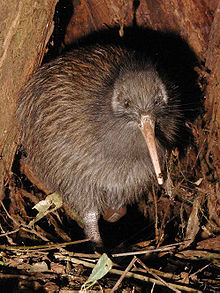
Kiwis have a probing pecker that allows them to detect motility
The bill tip organ is a region constitute about the tip of the bill in several types of birds that provender especially by probing. The region has a high density of nerve endings known as the corpuscles of Herbst. This consists of pits in the bill surface which in the living bird is occupied by cells that sense pressure changes. The supposition is that this allows the bird to perform 'remote touch', which means that it tin discover movements of animals which the bird does not directly touch on. Bird species known to take a 'beak-tip organ' include ibisis, shorebirds of the family Scolopacidae, and kiwis.[116]
There is a suggestion that across these species, the bill tip organ is improve-developed among species foraging in wet habitats (water cavalcade, or soft mud) than in species using a more terrestrial foraging. Still, it has been described in terrestrial birds too, including parrots, who are known for their dextrous extractive foraging techniques. Unlike probing foragers, the tactile pits in parrots are embedded in the hard keratin (or rhamphotheca) of the bill, rather than the bone, and along the inner edges of the curved pecker, rather than being on the outside of the pecker.[117]
Come across also [edit]
- Bird anatomy – Anatomy of birds
- Rostrum (anatomy) – Anatomy term
- Snout – Extended part of an animal's mouth
Footnotes [edit]
- ^ For an explanation of desmognathous, aegithognathous, etc. with images encounter "Catalogue of Species". 1891 – via Archive.org. .
References [edit]
- ^ Partington, Charles Frederick (1835). The British cyclopæedia of natural history: Combining a scientific nomenclature of animals, plants, and minerals. Orr & Smith. p. 417.
- ^ a b c Proctor, Noble S.; Lynch, Patrick J. (1998). Manual of Ornithology: Avian construction and function. New Haven, CT: Yale Academy Press. p. 66. ISBN978-0-300-07619-6.
- ^ "Beak". Merriam-Webster . Retrieved one July 2016.
- ^ a b c d e f
Coues, Elliott (1890). Handbook of Field and General Ornithology. London, United kingdom: Macmillan and Co. pp. one, 147, 151–152, 155. OCLC 263166207. - ^ a b c d e f g h i j k
Gill, Frank B. (1995). Ornithology (2nd ed.). New York, NY: Due west.H. Freeman and Company. pp. 149, 427–428. ISBN978-0-7167-2415-5. - ^ Seki, Yasuaki; Bodde, Sara G.; Meyers, Marc A. (2009). "Toucan and hornbill beaks: A comparative study" (PDF). Acta Biomaterialia. six (two): 331–343. doi:10.1016/j.actbio.2009.08.026. PMID 19699818. Archived from the original (PDF) on 2012-04-02.
- ^ Olsen, A.M. (3–7 January 2012). Beyond the beak: Modeling avian cranial kinesis and the evolution of bird skull shapes. Social club for Integrative & Comparative Biology. Charleston, South Carolina.
- ^ Mayr, Gerald (2005). "A new eocene Chascacocolius-similar mousebird (Aves: Coliiformes) with a remarkable gaping adaptation" (PDF). Organisms, Diversity & Evolution. five (3): 167–171. doi:10.1016/j.ode.2004.10.013.
- ^ Kaiser, Gary W. (2007). The Inner Bird: Beefcake and Evolution. Vancouver, BC: UBC Press. p. 19. ISBN978-0-7748-1343-3.
- ^ a b c d due east f g h i j k l thousand northward o p q r south
Campbell, Bruce; Lack, Elizabeth, eds. (1985). A Dictionary of Birds. Carlton, England: T and A.D. Poyser. ISBN978-0-85661-039-four. - ^ Girling (2003), p. iv.
- ^ Samour (2000), p. 296.
- ^ Bonser, R.H. & Witter, Thou.South. (1993). "Indentation hardness of the bill keratin of the European starling" (PDF). The Condor. 95 (iii): 736–738. doi:10.2307/1369622. JSTOR 1369622.
- ^ Beddard, Frank East. (1898). The structure and nomenclature of birds. London, Uk: Longmans, Green and Co. p. 5.
- ^ Pitocchelli, Jay; John F. Piatt; Harry R. Carter (2003). "Variation in plumage, molt, and morphology of the Whiskered Auklet (Aethia pygmaea) in Alaska". Journal of Field Ornithology. 74 (1): ninety–98. doi:10.1648/0273-8570-74.1.90. S2CID 85982302.
- ^ Knopf, F.L. (1974). "Schedule of presupplemental molt of white pelicans with notes on the bill horn" (PDF). Condor. 77 (3): 356–359. doi:ten.2307/1366249. JSTOR 1366249.
- ^ Chernova, O.F.; Fadeeva, E.O. (2009). "The peculiar architectonics of profile feathers of the emu (Dromaius novaehollandiae, Struthioniformes)". Doklady Biological Sciences. 425: 175–179. doi:x.1134/S0012496609020264. S2CID 38791844.
- ^ Hieronymus, Tobin L.; Witmer, Lawrence M. (2010). "Homology and evolution of avian compound rhamphothecae". The Auk. 127 (3): 590–604. doi:10.1525/auk.2010.09122. S2CID 18430834.
- ^ a b c Stettenheim, Peter R. (2000). "The Integumentary Morphology of Modern Birds—An Overview". Integrative and Comparative Biology. 40 (4): 461–477. doi:x.1093/icb/40.4.461.
- ^ Klasing, Kirk C. (1999). "Avian gastrointestinal anatomy and physiology". Seminars in Avian and Exotic Pet Medicine. 8 (2): 42–50. doi:x.1016/S1055-937X(99)80036-10.
- ^ Ferguson-Lees, James; Christie, David A. (2001-01-01). Raptors of the Globe. London, UK: Christopher Helm. p. 66. ISBN978-0-7136-8026-iii.
- ^ Harris, Tony; Franklin, Kim (2000). Shrikes and Bush-Shrikes. London, Uk: Christopher Helm. p. 15. ISBN978-0-7136-3861-5.
- ^ Feeding in vertebrates : evolution, morphology, beliefs, biomechanics. Five. L. Bels, Ian Q. Whishaw. Cham, Switzerland. 2019. ISBN978-3-030-13739-7. OCLC 1099968357.
{{cite book}}: CS1 maint: others (link) - ^ Gosner, Kenneth L. (June 1993). "Scopate tomia: An adaptation for handling hard-shelled prey?" (PDF). The Wilson Bulletin. 105 (2): 316–324.
- ^ Ornelas, Juan Francisco. "Serrate Tomia: An Adaptation for Nectar Robbing in Hummingbirds?" (PDF). The Auk. 111 (three): 703–710.
- ^ Madge, Steve; Burn down, Hilary (1988). Wildfowl. London, UK: Christopher Captain. pp. 143–144. ISBN978-0-7470-2201-5.
- ^ a b c Pyle, Peter; Howell, Steve Due north. One thousand.; Yunick, Robert P.; DeSante, David F. (1987). Identification Guide to Due north America Passerines. Bolinas, CA: Slate Creek Printing. pp. 6–7. ISBN978-0-9618940-0-nine.
- ^ a b Borras, A.; Pascual, J.; Senar, J. C. (Autumn 2000). "What Do Different Pecker Measures Measure out and What Is the All-time Method to Use in Granivorous Birds?" (PDF). Journal of Field Ornithology. 71 (four): 606–611. doi:x.1648/0273-8570-71.4.606. JSTOR 4514529. S2CID 86597085.
- ^ Mullarney, Svensson, Zetterström & Grant (1999) p. 357
- ^ Mullarney, Svensson, Zetterström & Grant (1999) p. 15
- ^ a b Howell (2007), p. 23.
- ^ Russell, Peter J.; Wolfe, Stephen L.; Hertz, Paul E.; Starr, Cecie (2008). Biological science: The Dynamic Science. Vol. 2. Belmont, CA: Thomson Brooks / Cole. p. 1255. ISBN978-0-495-01033-three.
- ^ Newman, Kenneth B. (2000). Newman's birds by color. Struik. p. 14. ISBN978-1-86872-448-2.
- ^ Wheelwright, Due north.T. (1985). "Fruit size, gape width and the diets of fruit-eating birds" (PDF). Ecology. 66 (3): 808–818. doi:10.2307/1940542. JSTOR 1940542. Archived from the original (PDF) on 2016-04-08. Retrieved 2013-ten-31 .
- ^ Soler, J.J.; Avilés, J.Chiliad. (2010). Halsey, Lewis George (ed.). "Sibling competition and conspicuousness of nestling gapes in altricial birds: A comparative written report". PLoS I. 5 (v): e10509. Bibcode:2010PLoSO...510509S. doi:10.1371/journal.pone.0010509. PMC2865545. PMID 20463902.
- ^ Hauber, Mark & Rebecca G. Kilner (2007). "Coevolution, communication, and host-chick mimicry in parasitic finches: who mimics whom?" (PDF). Behav. Ecol. Sociobiol. 61 (4): 497–503. doi:10.1007/s00265-006-0291-0. S2CID 44030487. Archived from the original (PDF) on 2012-03-20.
- ^ Hunt, Sarah; Kilner, Rebecca M.; Langmore, Naomi E.; Bennett, Andrew T.D. (2003). "Conspicuous, ultravioletrich mouth colours in begging chicks". Biological science Messages. 270: Due south‑25–S‑28. doi:x.1098/rsbl.2003.0009. PMC1698012. PMID 12952627.
- ^ Schuetz, Justin G. (October 2005). "Reduced growth but not survival of chicks with altered gape patterns". Animal Behaviour. lxx (4): 839–848. doi:10.1016/j.anbehav.2005.01.007. ISSN 0003-3472. S2CID 53170955.
- ^ Nicola, Saino; Roberto, Ambrosini; Roberta, Martinelli; Paola, Ninni; Anders Pape, Møller (2003). "Gape coloration reliably reflects immunocompetence of barn eat (Hirundo rustica) nestlings" (PDF). Behavioral Ecology. 14 (ane): 16–22. doi:10.1093/beheco/14.1.16. Archived from the original (PDF) on 11 July 2011. Retrieved 27 June 2010.
- ^ Noble, D.G.; Davies, Northward.B.; Hartley, I.R.; McRae, South.B. (July 1999). "The Reddish Gape of the Nestling Cuckoo (Cuculus canorus) is non a supernormal stimulus for 3 common hosts". Behaviour. 136 (9): 759–777. doi:x.1163/156853999501559. JSTOR 4535638.
- ^ Tanaka, Keita D.; Morimoto, Gen; Ueda, Keisuke (2005). "Yellowish wing-patch of a nestling Horsfield's hawk cuckoo Cuculus fugax induces miscognition past hosts: Mimicking a gape?". Periodical of Avian Biology. 36 (5): 461–64. doi:10.1111/j.2005.0908-8857.03439.x. Archived from the original on 2012-10-21.
- ^ Zickefoose, Julie. "Backyard Mystery Birds". Bird Watcher's Digest. Retrieved 2010-06-25 .
- ^ a b Capainolo, Peter; Butler, Ballad (2010). How Fast Tin can a Falcon Dive?. New Brunswick, NJ: Rutgers University Printing. p. 51. ISBN978-0-8135-4790-9.
- ^ Gellhorn, Joyce (2007). White-tailed ptarmigan: Ghosts of the alpine tundra. Bedrock, CO: Johnson Books. p. 110. ISBN978-one-55566-397-1.
- ^ Ehrlich, Paul R.; Dobkin, David South.; Wheye, Darryl (1998). The Birder's Handbook: A field guide to the natural history of North American birds. New York, NY: Simon and Schuster. p. 209. ISBN978-0-671-65989-9.
- ^ Carboneras, Carlos (1992). "Family Diomedeidae (Albatrosses)". In del Hoyo, Josep; Elliott, Andrew; Sargatal, Jordi (eds.). Handbook of Birds of the Globe. Vol. 1: Ostrich to Ducks. Barcelona: Lynx Edicions. p. 199. ISBN978-84-87334-x-viii.
- ^ Whitney, William Dwight; Smith, Benjamin Eli (1911). The Century Dictionary and Cyclopedia. Vol. six. New York: The Century Company. p. 4123. LCCN 11031934.
- ^ Bock, Walter J. (1989). "Organisms every bit functional machines: A connectivity explanation". American Zoologist. 29 (3): 1119–1132. doi:10.1093/icb/29.3.1119. JSTOR 3883510.
- ^ Tudge, Colin (2009). The Bird: A natural history of who birds are, where they came from, and how they live. New York, NY: Crown Publishers. p. 140. ISBN978-0-307-34204-1.
- ^ Kaplan, Gisela T. (2007). Tawny Frogmouth . Collingwood, Victoria: Csiro Publishing. pp. 40–41. ISBN978-0-643-09239-6.
- ^ Harris, Mike P. (2014). "Crumbling Atlantic puffins Fratercula arctica in summer and winter" (PDF). Seabird. Heart for Ecology & Hydrology. 27: 22–40. Archived from the original (PDF) on June 11, 2016.
- ^ "Skomer Island Puffin" (PDF). www.welshwildlife.org (factsheet). May 2011.
- ^ Webster's Entire Lexicon of the English Language
- ^ Eleanor Lawrence (2008). Henderson's Dictionary of Biology (14th ed.). Pearson Benjamin Cummings Prentice Hall. p. 111. ISBN978-0-321-50579-viii.
- ^ Jupiter, Tony; Parr, Mike (2010). Parrots: A Guide to Parrots of the World. A&C Black. p. 17. ISBN978-1-4081-3575-iv.
- ^ a b Mougeo, François; Approach, Beatriz E. (22 June 2006). "Ultraviolet reflectance past the cere of raptors". Biological science Letters. 2 (2): 173–176. doi:10.1098/rsbl.2005.0434. PMC1618910. PMID 17148356.
- ^ Parejo, Deseada; Avilés, Jesús M.; Rodriguez, Juan (23 Apr 2010). "Visual cues and parental favouritism in a nocturnal bird". Biology Letters. 6 (ii): 171–173. doi:10.1098/rsbl.2009.0769. PMC2865047. PMID 19864276.
- ^ Leopold, Aldo Starker (1972). Wildlife of Mexico: The Game Birds and Mammals. Berkeley, CA: University of California Press. p. 202. ISBN978-0-520-00724-6.
- ^ Alderton, David (1996). A Birdkeeper's Guide to Budgies. Tetra Press. p. 12.
- ^ King & McLelland (1985) p. 376
- ^ a b Elliot, Daniel Giraud (1898). The Wild Fowl of the The states and British Possessions. New York, NY: F. P. Harper. p. xviii. LCCN 98001121.
- ^ Perrins, Christopher M. (1974). Birds. London, UK: Collins. p. 24. ISBN978-0-00-212173-vi.
- ^ Petrie, Chuck (2006). Why Ducks Do That: 40 distinctive duck behaviors explained and photographed. Minocqua, WI: Willow Creek Press. p. 31. ISBN978-one-59543-050-two.
- ^ Goodman, Donald Charles; Fisher, Harvey I. (1962). Functional Anatomy of the Feeding Apparatus in Waterfowl (Aves: Anatidae). Carbondale, IL: Southern Illinois University Press. p. 179. OCLC 646859135.
- ^ King & McLelland (1985) p. 421
- ^ Dunn, Jon L.; Alderfer, Jonathan, eds. (2006). Field Guide to the Birds of Northward America (v ed.). Washington, DC: National Geographic. p. twoscore. ISBN978-0-7922-5314-iii.
- ^ Mullarney, Svensson, Zetterström & Grant (1999) p. 40
- ^ a b Lederer, Roger J. "The Part of Avian Rictal Bristles" (PDF). The Wilson Bulletin. 84 (2): 193–197.
- ^ a b Conover, Michael R.; Miller, Don Eastward. (November 1980). "Rictal Bristle Role in Willow Flycatcher" (PDF). The Condor. 82 (4): 469–471. doi:ten.2307/1367580. JSTOR 1367580.
- ^ a b c Cunningham, Susan J.; Alley, Maurice R.; Castro, Isabel (January 2011). "Facial Bristle Feather Histology and Morphology in New Zealand Birds: Implications for Part". Periodical of Morphology (PDF). 272 (1): 118–128. doi:10.1002/jmor.10908. PMID 21069752. S2CID 20407444.
- ^ a b Perrins, Christopher K.; Attenborough, David; Arlott, Norman (1987). New Generation Guide to the Birds of Britain and Europe. Austin, TX: University of Texas Press. p. 205. ISBN978-0-292-75532-ane.
- ^ Clark, George A. Jr. (September 1961). "Occurrence and timing of egg teeth in birds" (PDF). The Wilson Bulletin. 73 (3): 268–278.
- ^ Harris, Tim, ed. (2009). National Geographic Complete Birds of the World. Washington, DC: National Geographic. p. 23. ISBN978-i-4262-0403-6.
- ^ Kaiser, Gary W. (2007). The Inner Bird: Anatomy and evolution. Vancouver, BC: University of Washington Press. p. 26. ISBN978-0-7748-1344-0.
- ^ Ralph, Charles Fifty. (May 1969). "The Command of Color in Birds". American Zoologist. nine (ii): 521–530. doi:10.1093/icb/9.2.521. JSTOR 3881820. PMID 5362278.
- ^ a b c d
Colina, Geoffrey E. (2010). National Geographic Bird Coloration. Washington, DC: National Geographic. pp. 62–66. ISBN978-1-4262-0571-2. - ^ a b c Rogers, Lesley J.; Kaplan, Gisela T. (2000). Songs, Roars and Rituals: Advice in birds, mammals and other animals . Boston, MA: Harvard University Press. pp. 20, 83, 155. ISBN978-0-674-00827-4.
- ^ a b c Jouventin, Pierre; Nolan, Paul M.; Örnborg, Jonas; Dobson, F. Stephen (February 2005). "Ultraviolet spots in rex and emperor penguins". The Condor. 113 (iii): 144–150. doi:10.1650/7512. S2CID 85776106.
- ^ Campbell, Bernard Grant, ed. (1972). Sexual Selection and the Descent of Human being: The Darwinian pin. New Brunswick, NJ: Transaction Publishers. p. 186. ISBN978-0-202-02005-1.
- ^ Thompson, Beak; Blom, Eirik A.T.; Gordon, Jeffrey A. (2005). Place Yourself: The 50 most common birding identification challenges. New York, NY: Houghton Mifflin Harcourt. p. 128. ISBN978-0-618-51469-iv.
- ^ O'Brien, Michael; Crossley, Richard; Karlson, Kevin (2006). The Shorebird Guide. New York, NY: Houghton Mifflin. p. 76. ISBN978-0-618-43294-3.
- ^ Howell (2007) p. 21
- ^ Parkes, A.Southward.; Emmens, C.Westward. (1944). "Effect of androgens and estrogens on birds". In Harris, Richard S.; Thimann, Kenneth Vivian (eds.). Vitamins and hormones. Vol. two. New York, NY: Bookish Press. p. 371. ISBN978-0-12-709802-ix.
- ^ Bhullar, Bhart-Anjan Due south.; Morris, Zachary S.; Sefton, Elizabeth Yard.; Tok, Atalay; Tokita, Masayoshi; Namkoong, Bumjin; Camacho, Jasmin; Burnham, David A.; Abzhanov, Arhat (July 2015). "A molecular mechanism for the origin of a key evolutionary innovation, the bird beak and palate, revealed by an integrative arroyo to major transitions in vertebrate history: DEVELOPMENTAL Mechanism FOR ORIGIN OF BIRD BEAK". Evolution. 69 (vii): 1665–1677. doi:10.1111/evo.12684. PMID 25964090. S2CID 205124061.
- ^ a b Abzhanov, Arhat; Protas, Meredith; Grant, B. Rosemary; Grant, Peter R.; Tabin, Clifford J. (2004-09-03). "Bmp4 and Morphological Variation of Beaks in Darwin's Finches". Science. 305 (5689): 1462–1465. Bibcode:2004Sci...305.1462A. doi:10.1126/science.1098095. ISSN 0036-8075. PMID 15353802. S2CID 17226774.
- ^ a b Abzhanov, Arhat; Kuo, Winston P.; Hartmann, Christine; Grant, B. Rosemary; Grant, Peter R.; Tabin, Clifford J. (Baronial 2006). "The calmodulin pathway and evolution of elongated beak morphology in Darwin's finches". Nature. 442 (7102): 563–567. Bibcode:2006Natur.442..563A. doi:ten.1038/nature04843. ISSN 0028-0836. PMID 16885984. S2CID 2416057.
- ^ Ito, Yoshihiro; Yeo, Jae Yong; Chytil, Anna; Han, Jun; Bringas, Pablo; Nakajima, Akira; Shuler, Charles F.; Moses, Harold L.; Chai, Yang (2003-11-01). "Conditional inactivation of Tgfbr2 in cranial neural crest causes crevice palate and calvaria defects". Development. 130 (21): 5269–5280. doi:10.1242/dev.00708. ISSN 1477-9129. PMID 12975342. S2CID 10925294.
- ^ Mallarino, R.; Grant, P. R.; Grant, B. R.; Herrel, A.; Kuo, Westward. P.; Abzhanov, A. (2011-03-08). "Two developmental modules establish 3D beak-shape variation in Darwin'south finches". Proceedings of the National Academy of Sciences. 108 (ten): 4057–4062. Bibcode:2011PNAS..108.4057M. doi:x.1073/pnas.1011480108. ISSN 0027-8424. PMC3053969. PMID 21368127.
- ^ Samour (2000) p. vii
- ^ Patel, Meera (Autumn 2007). "Platypus electroreception". Biological science 342: Animate being Behavior. Portland, OR: Reed College.
- ^ "Platypus". LiveScience. iv August 2014. 27572.
- ^ a b c d
Clayton, [scarce citation]; Lee, [deficient citation]; Tompkins, [deficient citation]; Brodie, [deficient citation] (September 1999). "Reciprocal Natural Selection on Host-Parasite Phenotypes" (PDF). The American Naturalist. 154 (iii): 261–270. doi:x.1086/303237. hdl:10536/DRO/DU:30056229. ISSN 1537-5323. PMID 10506542. S2CID 4369897. [ full citation needed ] - ^ Pomeroy, D.E. (February 1962). "Birds with aberrant bills" (PDF). British Birds. 55 (ii): 49–72.
- ^ Boyd, [scarce citation] (1951). "A survey of parasitism of the Staling Sturnus vulgaris L. in Northward America". Journal of Parasitology. 37 (1): 56–84. doi:10.2307/3273522. JSTOR 3273522. PMID 14825028. [ full commendation needed ]
- ^ Worth, [deficient citation] (1940). "A note on the dissemination of Mallophage". Bird-Banding. xi: 23, 24. [ full commendation needed ]
- ^ Ash, [deficient citation] (1960). "A study of the mallophaga of birds with particular reference to their environmental". Ibis. 102: 93–110. doi:10.1111/j.1474-919X.1960.tb05095.ten. [ total commendation needed ]
- ^ Clayton, Dale H.; Moyer, Brett R.; Bush-league, Sarah Due east.; Jones, Tony K.; Gardiner, David West.; Rhodes, Barry B.; Goller, Franz (2005-04-22). "Adaptive significance of avian neb morphology for ectoparasite control". Proceedings of the Royal Guild of London B: Biological Sciences. 272 (1565): 811–817. doi:10.1098/rspb.2004.3036. ISSN 0962-8452. PMC1599863. PMID 15888414.
- ^ Moyer, Brett R.; Peterson, A. Townsend; Clayton, Dale H. (2002). "Influence of bill shape on ectoparasite load in western scrub-jays" (PDF). The Condor. 104 (3): 675–678. doi:x.1650/0010-5422(2002)104[0675:iobsoe]2.0.co;two. hdl:1808/16618. ISSN 0010-5422. S2CID 32708877.
- ^ Clayton, D.H.; Walther, B.A. (2001-09-01). "Influence of host environmental and morphology on the variety of Neotropical bird lice". Oikos. 94 (three): 455–467. doi:10.1034/j.1600-0706.2001.940308.x. ISSN 1600-0706.
- ^ Tattersall, Glenn J.; Andrade, Denis V.; Abe, Augusto South. (24 July 2009). "Heat Exchange from the Toucan Nib Reveals a Controllable Vascular Thermal Radiator". Scientific discipline. 325 (5949): 468–470. Bibcode:2009Sci...325..468T. doi:ten.1126/science.1175553. PMID 19628866. S2CID 42756257.
- ^ Greenbert, Russell; Danner, Raymond; Olsen, Brian; Luther, David (fourteen July 2011). "High summer temperature explains bill size variation in salt marsh sparrows". Ecography. online first (2): 146–152. doi:10.1111/j.1600-0587.2011.07002.10.
- ^ Phillips, Polly K.; Sanborn, Allen F. (December 1994). "An infrared, thermographic report of surface temperature in three ratites: Ostrich, emu and double-wattled cassowary". Journal of Thermal Biology. nineteen (6): 423–430. doi:10.1016/0306-4565(94)90042-half dozen.
- ^ "Evolution of bird bills: Birds reduce their 'heating bills' in cold climates". Science Daily. 23 June 2010. Retrieved 12 March 2012.
- ^ Bierma, Nathan (12 August 2004). "Add this to life list: 'Birding' has inspired flock of words". Chicago Tribune . Retrieved half-dozen June 2011.
- ^ Terres, John Yard. (1980). The Audubon Social club Encyclopedia of North American Birds. New York, NY: Alfred A. Knopf. ISBN978-0-394-46651-4.
- ^ Schreiber, Elizabeth Anne; Burger, Joanna, eds. (2002). Biology of Marine Birds . Boca Raton, FL: CRC Press. p. 325. ISBN978-0-8493-9882-vii.
- ^ Armstrong (1965) p. 7
- ^ Wilson, Edward O. (1980). Sociobiology. Boston, MA: Harvard University Press. p. 227. ISBN978-0-674-81624-4.
- ^ Amerson, A. Binion (May 1967). "Incidence and Transfer of Rhinonyssidae (Acarina: Mesostigmata) in Sooty Terns (Sterna fuscata)". Journal of Medical Entomology. four (2): 197–ix. doi:10.1093/jmedent/four.ii.197. PMID 6052126.
- ^ Park, F. J. (March 2011). "Avian trichomoniasis: A study of lesions and relative prevalence in a diverseness of captive and free-living bird species as seen in an Australian avian practice". The Journal of the Australia Veterinary Association. 89 (3): 82–88. doi:ten.1111/j.1751-0813.2010.00681.ten. PMID 21323655.
- ^ Partridge, Eric (2001). Shakespeare'south earthy (4 ed.). London, U.k.: Routledge Classics 2001. p. 82. ISBN978-0-415-25553-0.
- ^ Burton, Maurice; Burton, Robert (1980). The International Wildlife Encyclopedia. Vol. 12. New York, NY: Marshall Cavendish Corp. p. 1680.
- ^ a b Grandin, Temple (2010). Improving Animal Welfare: A practical approach. Oxfordshire, United kingdom: CABI. p. 110. ISBN978-1-84593-541-2.
- ^ Foster & Smith. "Bird Beaks: Anatomy, care, and diseases". Veterinary & Aquatic Services Department. Archived from the original on 4 June 2012. Retrieved xvi April 2012.
{{cite spider web}}: CS1 maint: uses authors parameter (link) - ^ Ash, Lydia (2020) [2004]. "Coping your Raptor". The Mod Apprentice. Archived from the original on 2005-04-06. Retrieved 16 April 2012.
- ^ Cunningham, Susan J.; Aisle, Thousand.R.; Castro, I.; Potter, Thou.A.; Cunningham, K.; Pyne, G.J. (2010). "Neb morphology or Ibises suggests a remote-tactile sensory system for casualty detection". The Auk. 127 (two): 308–316. doi:ten.1525/auk.2009.09117. S2CID 85254980.
- ^ Demery, Zoe P.; Chappell, J.; Martin, G.R. (2011). "Vision, bear on and object manipulation in Senegal parrots Poicephalus senegalus". Proceedings of the Royal Social club B. 278 (1725): 3687–3693. doi:x.1098/rspb.2011.0374. PMC3203496. PMID 21525059.
Bibliography [edit]

Wikimedia Commons has media related to Beaks.
- Armstrong, Edward Allworthy (1965). Bird Display and Behaviour: An introduction to the study of bird psychology . New York, NY: Dover Publications. LCCN 64013457.
- Campbell, Bruce; Lack, Elizabeth, eds. (1985). A Dictionary of Birds. Carlton, England: T and A.D. Poyser. ISBN978-0-85661-039-4.
- Coues, Elliott (1890). Handbook of Field and Full general Ornithology. London, UK: Macmillan and Co. p. i. OCLC 263166207.
- Gilbertson, Lance (1999). Zoology Lab Manual (iv ed.). New York, NY: McGraw Loma Companies. ISBN978-0-07-237716-three.
- Gill, Frank B. (1995). Ornithology (2 ed.). New York, NY: W.H. Freeman and Company. ISBN978-0-7167-2415-five.
- Girling, Simon (2003). Veterinary Nursing of Exotic Pets. Oxford, UK: Blackwell Publishing. ISBN978-1-4051-0747-1.
- Hill, Geoffrey Eastward. (2010). National Geographic Bird Coloration. Washington, DC: National Geographic. ISBN978-one-4262-0571-two.
- Howell, Steve North. Yard. (2007). Gulls of the Americas. New York, NY: Houghton Mifflin Company. ISBN978-0-618-72641-7.
- King, Anthony Stuart; McLelland, John, eds. (1985). Form and Function in Birds. Vol. 3. London, UK: Academic Printing. ISBN978-0-12-407503-0.
- Mullarney, Killian; Svensson, Lars; Zetterström, Dan; Grant, Peter J. (1999). Collins Bird Guide: The Virtually Complete Field Guide to the Birds of United kingdom and Europe. London, UK: Harper Collins. ISBN978-0-00-711332-3.
- Proctor, Noble S.; Lynch, Patrick J. (1998). Manual of Ornithology: Avian Structure and Function. New Oasis, CT: Yale Academy Press. ISBN978-0-300-07619-6.
- Rogers, Lesley J.; Kaplan, Gisela T. (2000). Songs, Roars and Rituals: Advice in birds, mammals and other animals . Boston, MA: Harvard University Press. ISBN978-0-674-00827-4.
- Samour, Jaime, ed. (2000). Avian Medicine. London, UK: Mosby. ISBN978-0-7234-2960-9.

A Bird Without Wings Meaning,
Source: https://en.wikipedia.org/wiki/Beak
Posted by: taylorinquen.blogspot.com
0 Response to "A Bird Without Wings Meaning"
Post a Comment